
Fair Launches Without Bonding Curves: How Titan Deployer Uses One-Sided Uniswap V3 Liquidity
Why Titan Deployer skips the bonding-curve-and-graduation model: one-sided Uniswap V3 liquidity gives every token a real DEX market from block one, with the liquidity locked forever.
Published · Last reviewed · Titan Locker
Bonding-curve launchpads popularized fair token launches, but the curve itself was always a workaround. This article explains the mechanism Titan Deployer uses instead — a one-sided Uniswap V3 position holding the token's entire supply, locked permanently at creation — and why it delivers the same fairness guarantees with a simpler, more composable market.
What bonding-curve launchpads actually do
On a pump.fun-style launchpad, a new token first trades against a virtual bonding curve: an internal price formula, not a DEX pool. When cumulative buying pushes the price past a threshold, the platform "graduates" the token — creating a real pool and migrating liquidity into it. The curve guarantees a uniform starting price, which is the fair part. But it also means two different market structures over the token's life, a migration event that can be front-run or gamed, and a pre-graduation period where the token is invisible to DEX routers, aggregators, and portfolio tools.
The one-sided alternative
Uniswap V3's concentrated liquidity makes the curve unnecessary. A position can be minted with only tokens — no quote currency — covering a price range that starts at the launch price. Economically this behaves like a bonding curve: the first buyer pays the opening price, and each subsequent buy walks the price up the range, converting pool tokens into USDT0 held by the position. The difference is that this "curve" is a real Uniswap V3 pool from the first second, so there is nothing to graduate and nothing to migrate.
- Uniform starting price — the pool opens at a $2,000 market cap for the full 1,000,000,000 supply; creator dev buys execute against it like any other swap.
- No seed capital — the creator deposits no USDT0; the supply itself is the liquidity.
- Full composability from block one — routers, MEV bots, aggregators, and portfolio trackers see a standard V3 pool immediately.
- One price history — charts, candles, and PnL are continuous from the first trade; there is no curve-to-pool discontinuity.
Locking, not trusting
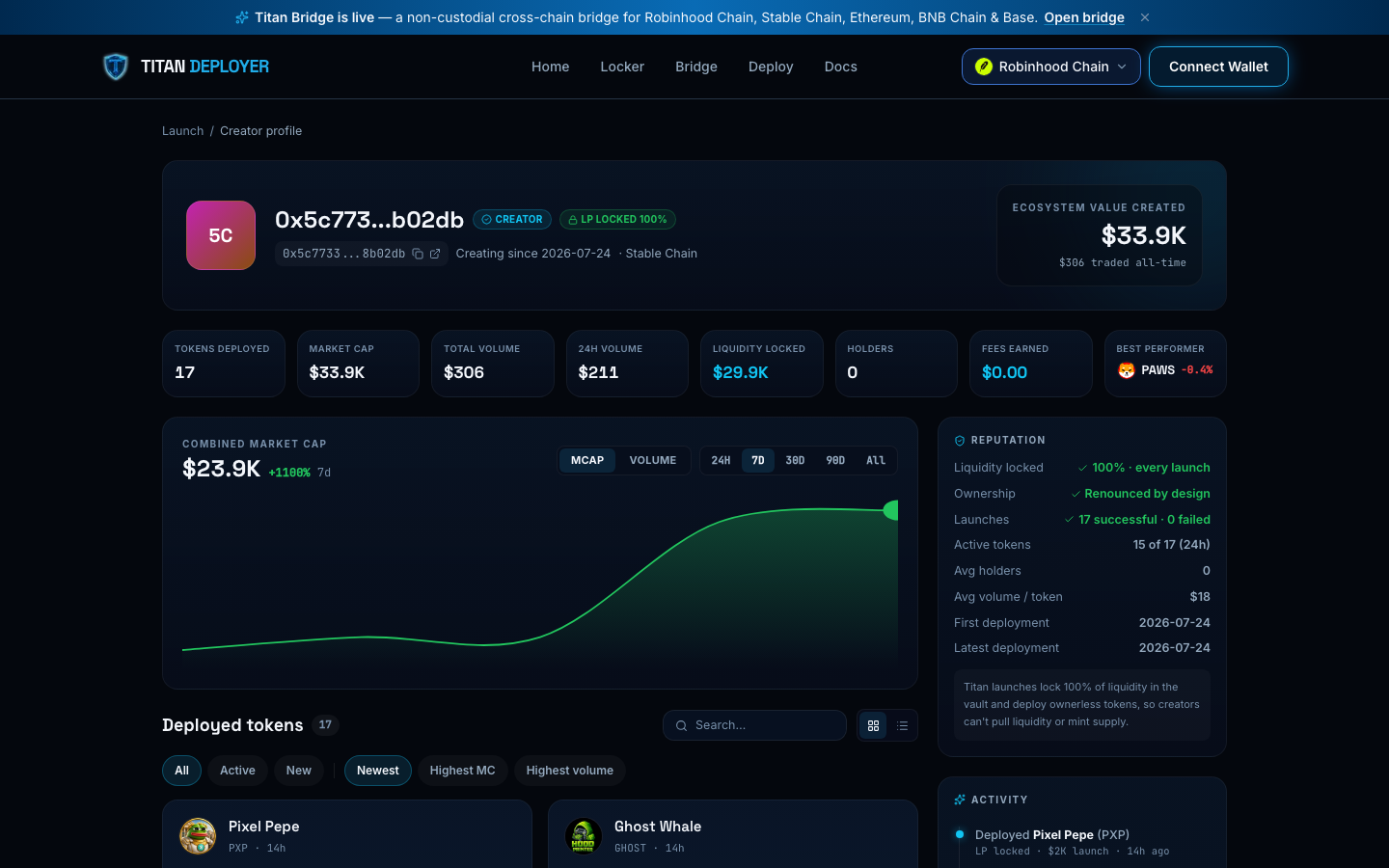
A real pool at launch would be a step backward if the deployer could withdraw it. Titan Deployer closes that path in the launch transaction itself: the position NFT is locked in the Titan Locker vault — the same audited locker infrastructure that secures LP for other projects — with no unlock time and no override. What the position still produces is trading fees (the pool uses the 1% fee tier), and those route through the deployer's fixed split: 60% to the creator, 40% to the Titan treasury, with a contract-level cap keeping the treasury share at or below 50%.
Trade-offs, honestly
The model has consequences worth understanding. Because all liquidity sits above the launch price, early markets are thin and volatile — small trades move the price a lot, which is why the Titan interface defaults to 5% slippage and labels whale trades. And because the market is real from the start, there is no curve phase filtering out bots: launches are open combat from block one. Titan's answer is transparency rather than gating — live 1-second charts, dev-buy badges, holder tags, and a public realized-PnL leaderboard per token.
Verifying the claims
Everything above is checkable on-chain: the deployer's launchFee() returns zero, the pool and its 1% fee tier are visible on Stablescan, the position NFT sits in the Titan Locker vault, and every fee claim emits an event that the public API indexes into per-creator history. Fair launches shouldn't require trusting a website — on Titan Deployer they don't.
Frequently asked questions
Is a one-sided Uniswap V3 position the same as a bonding curve?
Economically similar — price rises deterministically as buys consume the range — but structurally different: it's a real DEX pool from the first block, so there is no graduation, no migration, and full router/aggregator compatibility immediately.
Why don't Titan Deployer tokens need graduation?
Graduation exists to move a token from an internal curve into a real pool. Titan Deployer tokens start in the real pool, so there is nothing to migrate.
What stops the deployer from pulling the liquidity?
The liquidity position is locked in the Titan Locker vault for 100 years during the launch transaction, and the deployer exposes no withdraw function — only a permissionless extend. Only accrued trading fees can be claimed.
Why are new launches so volatile?
A $2,000 starting market cap with one-sided liquidity means early liquidity is intentionally thin — small trades move the price sharply in both directions. That is inherent to fair micro-cap launches, not specific to Titan.
Glossary
- Bonding curve
- A price formula that quotes a token from an internal reserve rather than a DEX pool; used by some launchpads for the pre-graduation phase of a token's life.
- Graduation
- On bonding-curve launchpads, the migration of a token from the internal curve into a real DEX pool once a market-cap threshold is reached. Titan Deployer has no graduation because tokens start in a real pool.